- Home
- Daily routine charts for kids
Daily routine charts for kids
A daily routine chart turns the same steps into the same order, every single day. Your child reads it top to bottom, checks each step, and races the clock. This page has free printable routine charts for kids aged 3 to 10 that you can hang tonight.

Download the charts
One-page PDFs with a blank name line. Pick paper and ink once, every button changes.
What a routine chart does that a chore chart does not
A chore chart lists jobs. A routine chart lists a sequence, and the sequence is what teaches the habit. The same order every day means your child stops asking what comes next and just moves.
A routine chart works for kids aged 3 to 9, because the order is always the same. Hang it on the door they use, the one they walk out of in the morning or come in after school. That is where the routine actually happens.
The chart does the reminding, so you do not have to. Your child follows the chart without being told bceause the steps are familiar and the clock is the boss.
The morning routine chart
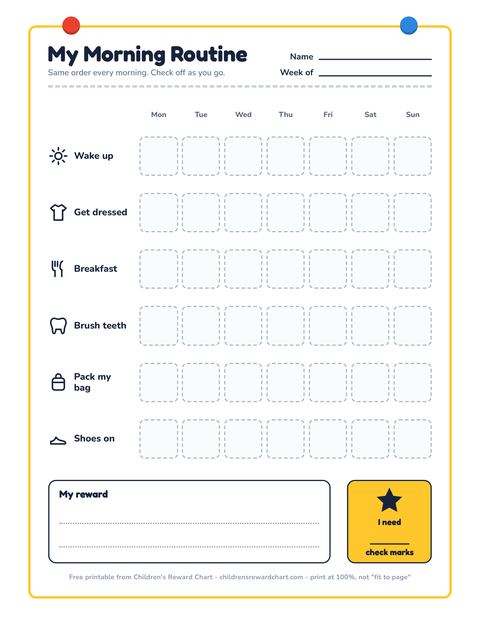
The morning routine chart printable is a list of steps in order, with a picture for each step. There is a check box per step per day, and a reward line at the the bottom. The clock rule is simple: the routine is done before the time written on the chart.
Print it at 100 percent, not fit to page. Choose letter or A4, and a color version or an ink saving black outline version. The blank name line is ready for a marker.
The reward is the routine finishing before the clock does, so the chart works without a sticker for every step. The boxes fit a 1.5 inch round sticker or a 1/2 inch star sticker if you want to add them.
The after school routine chart
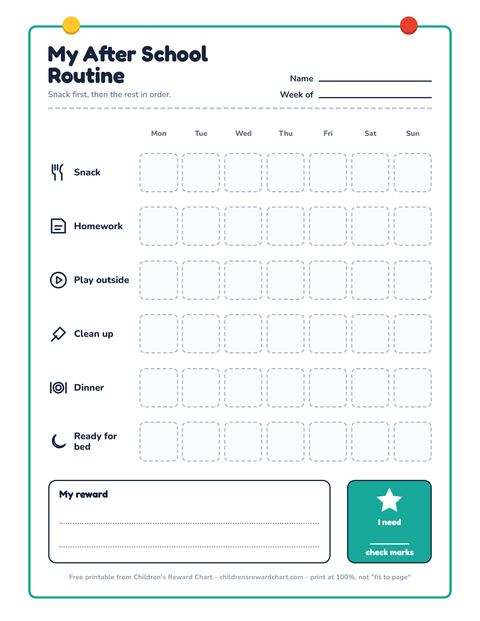
The after school routine chart printable follows the same idea: a list of steps in order, a check per step, and a reward line. The steps are snack, homework, play outside, clean up, dinner, and ready for bed.
This chart helps the after school hours move without nagging. Your child checks each step as it is done, and the order stays the same every day. Print letter or A4, color or ink saving.
The check mark is the proof of progress, and the reward line at the bottom is for the whole routine done before the time. You can use a star sticker or just a high five.
Building a routine in one week
You do not need to invent a new routine. You need to write down the one your child already does, in the order it happens. Here is a five step plan to build a routine chart that sticks.
- Write the steps your child already does every morning or after school.
- Put them in the order they happen, from first to last.
- Add one new step, like making the bed or packing the backpack.
- Print the chart and hang it on the door they use.
- Walk it together for three days, pointing to each step as they do it.
After three days, your child will start checking steps on their own. Keep the same order for at least a week. The routine becomes automatic when the order never changes.
Routine charts by age
The number of steps and who checks them changes with age. Here is a simple guide for what to put on the chart and how much help your child needs.
| Age | Steps on the chart | Who checks |
|---|---|---|
| 3 | 3 to 4 steps | Parent |
| 4 to 5 | 4 to 6 steps | Parent with child |
| 6 to 7 | 6 to 8 steps | Child with parent |
| 8 to 9 | 8 to 10 steps | Child alone |
For a 3 year old, keep the chart short and do the checking together. By age 8, the chart is a checklist they read and check on their own. The goal is that the chart becomes a habit, not a battle.
Responsibility charts and visual schedules
A routine chart is one kind of visual schedule. The responsibility chart on the next page adds a weekly view with more jobs. For non-readers, picture only charts work best, and the toddler chart uses simple images.
Some children need a visual schedule that shows the whole day, not just one routine. The feelings chart can help a child name emotions during transitions. Pick the chart that matches your child's reading level and attention span.
If you want more ideas for daily structure, see the bedtime routine chart or the chore charts for a different approach. For a step by step guide to making any chart, visit how to make a chore chart.
More routine charts
The responsibility chart for jobs a child owns.
Print it, then stick it to the fridge
Sticker paper that fits every chart on this site, and the bits that keep a chart up all week. Links go to Amazon and we may earn a commission.
Goes with a routine chart
A clock the child can read, a timer and the magnets for the door.
Questions parents ask
What is a daily routine chart?
A daily routine chart is a printable list of steps your child does in the same order every day, like getting ready for school or after school. It has a check box for each step and a reward line. The chart hangs on the door your child uses.
What should be on a morning routine chart?
A morning routine chart should have steps in the order your child does them, like wake up, get dressed, eat breakfast, brush teeth, and pack the backpack. Add a check per step and a reward line. The clock rule is the routine done before the time on the chart.
What age is a routine chart for?
A routine chart works for kids aged 3 to 10. For a 3 year old, use 3 to 4 steps and check together. For an 8 or 9 year old, use 8 to 10 steps and let them check alone. The chart grows with your child.
How is a routine chart different from a chore chart?
A chore chart lists jobs like taking out the trash or making the bed. A routine chart lists a sequence of steps in a fixed order, like morning or after school. The routine chart teaches the order, so your child follows it without being told.
How long until the routine sticks?
Most kids pick up a routine within one week if you keep the same order every day. Walk the chart together for the first three days. After that, the routine becomes automatic. Be consistent and the habit forms quickly.