Behavior reflection sheets and think sheets
A behavior reflection sheet is a calm way for a child to look back at what happened and decide what to do next time. This page gives you three free printables that end with the same question: What will I do next time?

Download the charts
One-page PDFs with a blank name line. Pick paper and ink once, every button changes.

Think Sheet
Reflection sheet for K to 2: faces to circle, drawing box, next time line.
Download letter PDF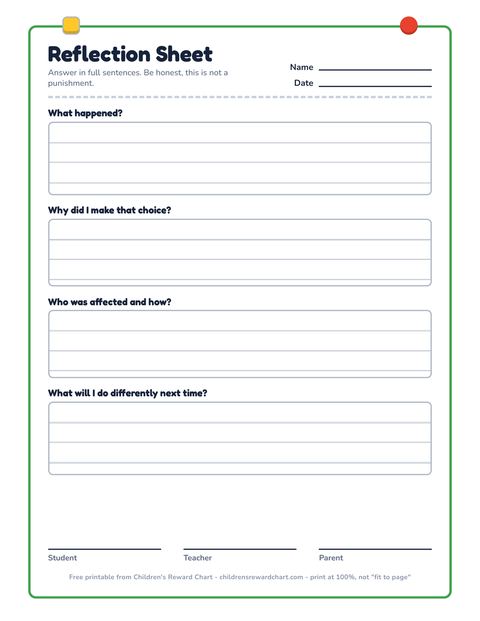
Reflection Sheet
Reflection sheet for grades 3 to 5: what happened, why, who was affected, plan.
Download letter PDF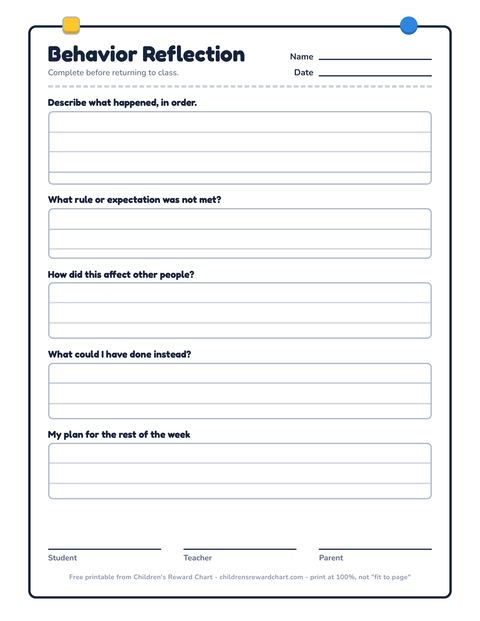
Behavior Reflection
Reflection report for grades 6 to 8 with a plan and signature lines.
Download letter PDFWhat a reflection sheet is for
A reflection sheet is a calm-down tool and a plan, not a punishment. You fill it in after the child has settled, not during the meltdown. The child reads it first, then the teacher, then home. Everyone sees the same four questions at every grade.
The four questions stay the same from kindergarten to eighth grade. Only the format changes. A younger child circles faces and draws. An older child writes sentences and a plan. That keeps the focus on the thinking, not the writing.
Use it tonight with your own child if a behavior report came home. Print one sheet, ask the four questions, and let your child lead the conversation. The sheet does the teaching, you do the listening.
The three sheets by grade
Each sheet asks the same four questions in a way the child can handle. The youngest version uses faces and drawing. The middle version uses short sentences. The oldest version uses paragraphs and a full plan.
| Grade | How the child answers | What is on the sheet |
|---|---|---|
| K to 2 | Circles faces, draws | Faces, boxes, one line to draw |
| 3 to 5 | Short sentences | Lines, sentence starters, a plan box |
| 6 to 8 | Paragraphs and a plan | Blank lines, a plan box, a signature |
All three sheets print on one page each. They are part of the free set on this page, and you can also use them with a /classroom/behavior-charts/ or a /feelings-charts/ nearby.
The last question is the same on every sheet: What will I do next time? That line is the one a skimming parent should catch, so it sits at the bottom in bold. The rest of the sheet is just the story of what happened.
The four questions
The four questions are: What happened? How did I feel? Who did it effect? What will I do next time? The first three set the stage. The last one is where the learning happens.
Why the last question matters most. A think sheet that stops at what happened is just a behavior report. A sheet that ends with next time gives the child a plan they can try the same day. That plan is the whole point.
Talk it through in two minutes. Read the child's answers out loud. Ask one follow-up question: What will you try first? Then let them go try it. You can check in later with a /behavior-charts/tracking-sheets/ or a simple note home.
Behavior reports home
The sheet doubles as a daily behavior report. Write a short note on the top or bottom: what the child did well, what they will try next time. Keep it to three lines or less. The child reads it, the teacher signs it, home initials it.
Send a good-news report as often as a bad one. If the child made a plan and folowed it, that is worth reporting. A positive behavior report builds trust. You can also use a /behavior-charts/color-coded/ to track the good days.
A daily behavior report pdf is included in the free set. Print a stack and keep them by the door. That way the sheet is ready when you need it, and it becomes a habit, not a hassle.
Using a think sheet without it becoming a punishment
A think sheet works best when it stays a calm tool. These six rules keep it that way.
- Never give it to the whole class as a worksheet.
- Send the child to a quiet spot to fill it in.
- The teacher reads it back to the child.
- The plan is tried the same day.
- File the sheet, do not display it.
- Keep a feelings chart nearby for help.
Keep the sheet private. A reflection sheet is between the child, the teacher, and home. It is not a public record. If the child needs help naming feelings, point to a feelings chart. If you want more ideas on how to respond, look at the /guides/positive-reinforcement-examples/ or the /classroom/ hub.
More classroom charts
Every page hands out its own chart. All classroom.
Classroom behavior charts
Whole-class + individual charts
Free printableStudent certificates and good behavior awards
Certificate pack
Free printableClassroom reward coupons (printable)
Coupon sheets
Free printableClassroom birthday chart (printable 12-month chart and board ideas)
12-month birthday chart, 4 and 6 lines
Free printableClassroom reward systems, charts and ideas
Class points chart
Free printableGuides for the classroom
Short guides that end at a chart you can print tonight.


Print it, then stick it to the fridge
Sticker paper that fits every chart on this site, and the bits that keep a chart up all week. Links go to Amazon and we may earn a commission.
Goes with the classroom charts
Pocket charts, sticker rolls, certificate paper and dry-erase pockets for a room of 25.
Questions parents ask
What is a behavior reflection sheet?
It is a printed page a child fills in after a behavior incident. It asks what happened, how the child felt, who it affected, and what they will do next time. It is a calm-down and a plan, not a punishment.
What age can use a think sheet?
The K to 2 version works for young children who can circle faces and draw. The 3 to 5 version uses short sentences. The 6 to 8 version uses paragraphs. Any age can use the sheet that matches their writing level.
What questions should be on a reflection sheet?
The four questions are: What happened? How did I feel? Who did it affect? What will I do next time? The last question matters most because it makes a plan for next time. All three sheets on this page end with that same line.
Is a reflection sheet a punishment?
No. It is a calm-down tool and a planning tool. The child fills it in after they are calm, in a quiet spot. The teacher reads it back and the plan is tried the same day. It is private, not displayed.