Behavior chart examples for home, with the goals that work
Pick a clear, pointable goal and name the exact moment the sticker goes on. This guide gives 12 photo-ready behavior chart examples you can copy tonight, each with four rows, a reward line, the child age, and the sticker or point moment.
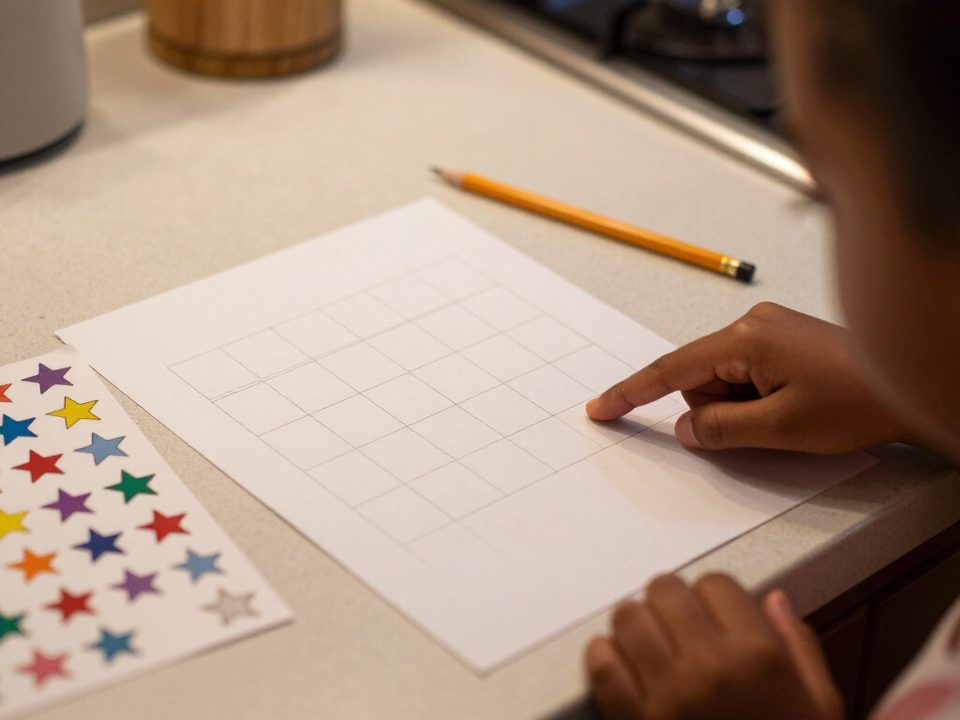
behavior chart examples parents can use tonight. Each example is written so you could photograph the chart: four rows, a reward line, the child age, and the exact moment the sticker goes on.
What makes a behavior chart goal work
A working goal is one a parent can point to. It must describe a single moment you watch. If you cannot show the moment, the chart will fizzle.
Test every goal three ways: can you point to it, is it a wanted action not a forbidden one, and can you award a sticker for one clear moment each day? These are quick checks you can run tonight.
- Pointable: point to the child doing it
- Wanted not unwanted: state what you want the child to do
- One moment a day: one clear sticker moment
Bad eaxmple rewritten: "Be good" is vague. Rewrite it as "Help clear the table at plate put-down." Now you can point to the moment and give the sticker.
For more on praising the right actions, see this short guide on positive reinforcement examples.
Behavior chart examples for a 3 year old
Three year olds need tiny, repeatable wins. These charts use same-day rewards so the child connects the sticker with the act.
Each chart below shows the four rows, the reward line, the age, and the moment the sticker goes on. Copy the wording onto a printable and hang it low.
- Chart A, Age 3: Rows: 1. Kind hands 2. Share one toy 3. Stay in bed at sleep time 4. Put cup in sink. Reward: sticker and bedtime story. Sticker moment: when child keeps hands to self during play.
- Chart B, Age 3: Rows: 1. Listening at first ask 2. Try one bite 3. Wash hands 4. Put shoes by door. Reward: same-day sticker. Sticker moment: when child follows the first instruction.
- Chart C, Age 3: Rows: 1. Use inside voice 2. Say please or thank you 3. Help pick up 4. Brush teeth. Reward: sticker and small toy tonight. Sticker moment: when child uses the word or action in the moment.
If you want printable options for little ones, check the toddlers and preschool page for matching designs.
Examples for 4 to 5 year olds
At four and five, you can add slightly longer tasks. Keep the sticker moment precise and short.
These charts use clear, home-ready goals. They fit a 1.5 inch round sticker or a 1/2 inch star sticker, so stickers feel tangible.
- Morning chart, Age 4: Rows: 1. Get dressed 2. Brush teeth 3. Eat breakfast 4. Backpack ready. Reward: sticker and screen time later. Sticker moment: when child finishes all morning steps.
- Sharing chart, Age 5: Rows: 1. Offer a toy 2. Take turns 3. Use kind words 4. Say sorry when needed. Reward: sticker and family game. Sticker moment: when child shares without a prompt.
- Calm voice chart, Age 4: Rows: 1. Calm voice at request 2. Use words, not hands 3. Stop after one warning 4. Say 'I need help'. Reward: sticker and cuddle time. Sticker moment: when child speaks calmly after a cue.
These small wins build habit. Hang the chart where the child can see it.
Examples for 6 to 8 year olds
School-age kids can handle tasks with a time boundary. Still, name the sticker moment and keep it observable.
Use the four-row format and a clear reward line that arrives soon after the win.
- First-time listening, Age 6: Rows: 1. Listen first ask 2. Ask questions if unsure 3. Follow three-step directions 4. Say 'okay'. Reward: sticker and choice of dessert tonight. Sticker moment: when child follows the first instruction within one minute.
- Homework-without-a-fight, Age 7: Rows: 1. Start homework 2. Work 20 minutes 3. Ask for help calmly 4. Put away materials. Reward: sticker and extra reading time. Sticker moment: when child begins homework without arguing.
- Sibling chart, Age 8: Rows: 1. Share space 2. No name-calling 3. Help with a chore 4. Say 'sorry' when hurt. Reward: sticker and pick game night. Sticker moment: when child helps or speaks kindly after a conflict.
If your child has attention differences, adapt timing and reward frequency. You can see more formats on the main behavior charts page.
Examples for 9 and up
Older kids often prefer points, not stickers. Points let them trade for bigger rewards.
Each example below lists points, the four tasks, the reward line, and the moment a point is earned.
- Screen-time chart, Age 9+: Rows: 1. Homework done 2. Chore done 3. Read 20 minutes 4. Help family. Reward: points toward screen minutes. Point moment: one point when the task is complete.
- Truth chart, Age 10: Rows: 1. Tell truth 2. Admit a mistake 3. Explain actions 4. Offer fix. Reward: points toward weekend privilege. Point moment: one point when child tells the truth without prompting.
- Self-checked chart, Age 11: Rows: 1. Morning routine done 2. Pack own bag 3. Check homework 4. Set alarm. Reward: points for a weekly treat. Point moment: one point when child self-reports and you confirm.
If you want printable charts for older kids, the site sign-up opens a builder that prints the child name on a sticker sheet, a star chart and a chore chart, made in your browser.
Goals that look fine and fail
Some goals sound good but do not pass the pointable test. The table below shows quick rewrites so you can photograph the chart and know when to award a sticker.
| Goal | Why it fails | Rewrite |
|---|---|---|
| be good | Vague, no moment | Help clear the table at plate put-down |
| no fighting | Defines a negative | Take turns at one play session |
| be nice to your sister | Too broad | Give sister a toy when she asks |
| listen | No pointable cue | Follow first instruction within one minute |
| behave at school | Not home-observable | Pack bag and hand teacher note |
| no whining | Focuses on stopping | Ask for help in a calm voice |
Use these rewrites when you write the four rows for a chart.
Rewards in the examples
Every example uses a small, immediate reward. Small rewards keep the feedback loop tight and make the sticker meaningful.
Rewards arrive soon after the earned sticker or as points accumulated over days. That keeps the expectation clear.
- Same-day sticker plus one small treat
- Sticker plus a short shared activity
- Points exchanged for minutes of screen time
For a long list of small and concrete options, see these reward ideas.
Printing the example that fits
Print the chart that fits your family. The site offers weekly, smiley and kindergarten styles in letter and A4, color and ink-saving versions.
Every chart prints at 100 percent, not fit to page. The reward boxes fit a 1.5 inch round sticker or a 1/2 inch star sticker.
- Weekly chart for day-by-day tracking
- Smiley chart for very visual kids
- Kindergarten chart with simple tasks
Grab the printable templates on the printable charts page. The sheets include a blank template you can type into before printing.
Charts that go with this guide
Free one-page PDFs with a blank name line. Pick paper and ink once, every button changes.


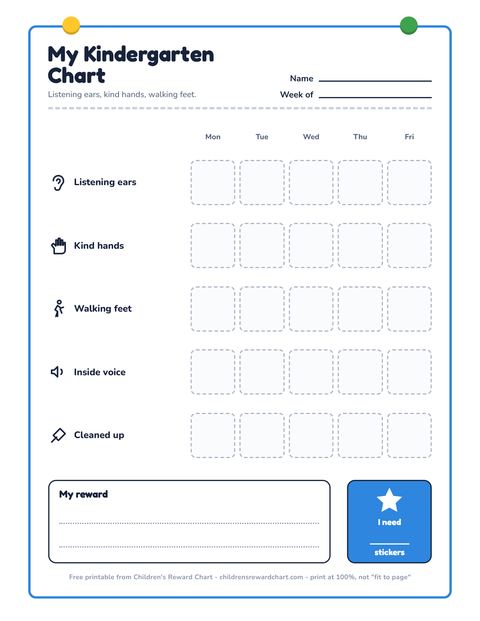
My Kindergarten Chart
School-week behavior chart with 5 picture rules for kindergarten.
Download letter PDFStickers and paper for the chart
The reinforcer has to be in the drawer before the first star is earned. Links go to Amazon and we may earn a commission.
Questions parents ask
What is an example of a behavior chart?
An example shows four clear rows, the child age, a reward line, and the sticker moment. For instance: 'Age 5: Get dressed, Brush teeth, Eat breakfast, Backpack ready. Reward: sticker tonight. Sticker moment: when morning tasks finish.'
What goals should I put on a behavior chart?
Pick goals you can point to, state the wanted action, and name the exact moment a sticker goes on. Short, observable acts work best, like 'follow first instruction' or 'put cup in sink at mealtime.'
How many behaviors should a chart track?
Four rows works well for most ages. It is enough variety without overwhelming the child. Older kids can track points, not stickers, if you need finer reward control.
What is a good behavior chart for a 4 year old?
A good chart has simple, repeatable tasks. Example: 'Get dressed, Brush teeth, Eat breakfast, Backpack ready.' Reward follows the morning routine. Sticker moment is when all morning tasks finish.
Should a behavior chart have consequences on it?
Charts work best with immediate, small rewards rather than harsh consequences. If you add consequences, keep them separate and clear. Focus the chart on what you want the child to do.
Read next
Short guides that end at a chart you can print tonight.

Positive reinforcement examples for kids, at home and in class
See real examples of positive reinforcement at home and in class, then print a chart that puts one into action tonight.
Positive vs negative reinforcement: what each one looks like with a child
Learn what negative reinforcement actually looks like with a child, and how to tell it apart from punishment, so you can choose the right chart.

Is rewarding good behavior bribery?
Get a clear answer on whether rewarding good behavior is bribery, and how to set up a chart that feels fair, not transactional.