- Home
- Reward and star charts
- Star chart for kids
Star chart for kids
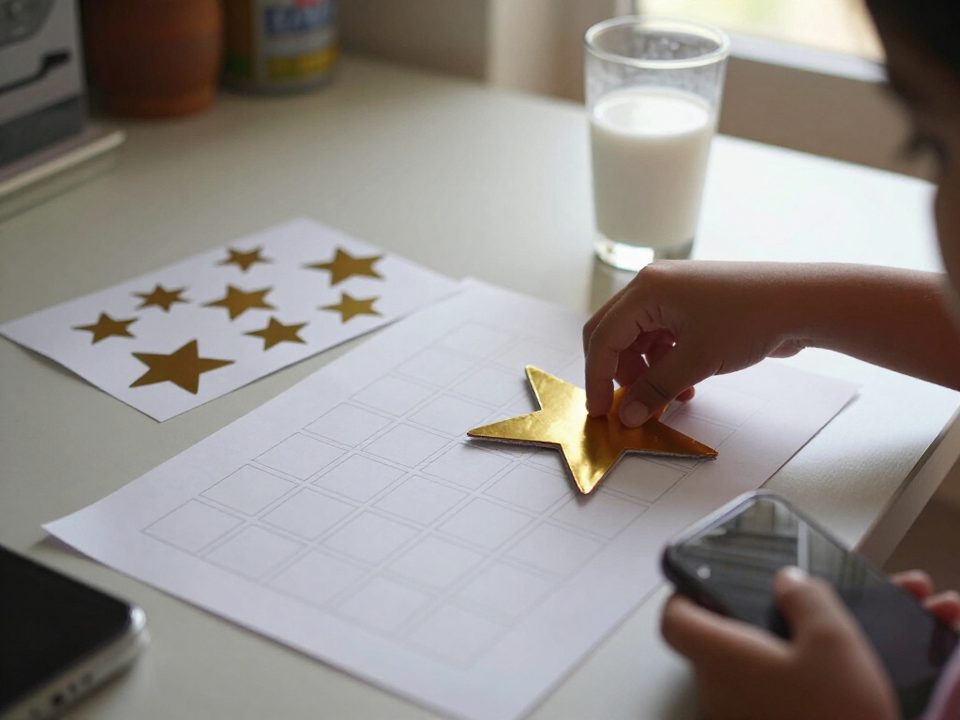
A star chart for kids is the simplest reward tool you can put on the fridge tonight. The free printables here use one thing only: a classic gold star sticker. Nothing else on the page competes with it.
Download the charts
One-page PDFs with a blank name line. Pick paper and ink once, every button changes.
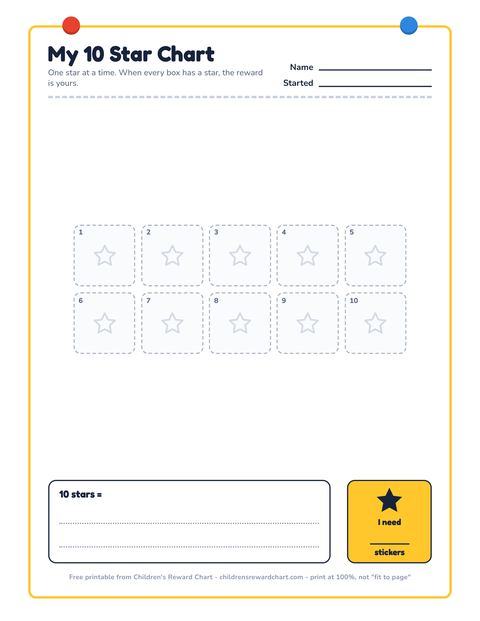
My 10 Star Chart
10 numbered star boxes and a reward line. Fits a 1/2 inch star sticker.
Download letter PDF
My 20 Star Chart
20 numbered star boxes and a reward line. Fits a 1/2 inch star sticker.
Download letter PDF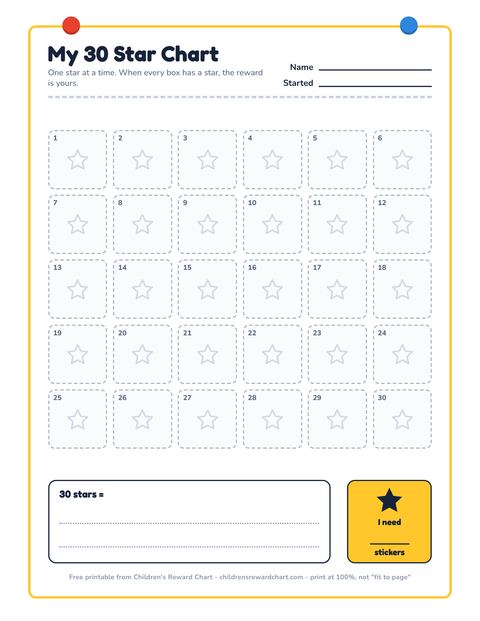
My 30 Star Chart
30 numbered star boxes and a reward line. Fits a 1/2 inch star sticker.
Download letter PDF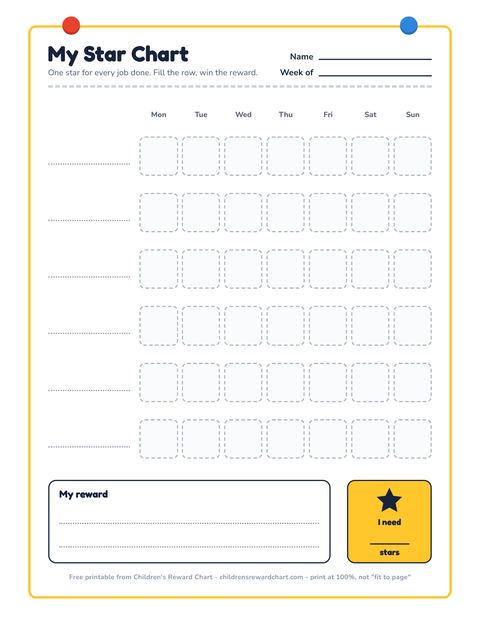
My Star Chart
7 days, 6 blank tasks, one reward box. The chart everyone starts with.
Download letter PDFThe star charts
You get four star charts in this set. Each one is a one-page PDF in letter and A4, in a color version and an ink saving black outline version. Every chart has a blank name line and a reward line at the bottom.
The main charts have 10, 20 and 30 numbered star boxes. The weekly star chart has seven rows with five boxes per row, so you can use it for a single child or a small group.
The star boxes are drawn to fit a half inch foil star sticker. Print at 100 percent, not fit to page. If you print at the wrong scale, the sticker will hang over the box edge.
The star boxes are the only shapes on the page, so the child's eye goes straight to the sticker spot.
Which star chart for which age
Pick the chart by how long the child can wait for a payoff. A 3 year old needs a reward after one or two stars. A 9 year old can work toward a full row or a whole chart.
The age bands below are a starting point, not a rule. Watch the child's reaction and adjust the timing.
| Age | Chart | Reward timing |
|---|---|---|
| 3 | 10 stars | After 1 to 2 stars |
| 4 to 5 | 20 stars | After 5 stars |
| 6 to 8 | 30 stars | After 10 stars |
| 9 plus | 30 stars | After full chart |
For a younger child, write the reward on the line in plain words: movie night, park trip, extra story. For an older child, let them write it themselves.
Gold stars and why they still work
A gold star is a reward in itself. The child does the task, peels the foil star, and presses it into the box. That small physical act is the the payoff, not just the promise of one later.
The foil star has a shine and a texture that a printed checkmark or a drawn smiley face does not. At 9, a child who has outgrown sticker books will still pick a gold star over a token or a tally mark.
Keep the star sheet in a drawer by the chart, not on the fridge. The child reaches for one star at a time, and the rest stay out of sight.
See the sticker paper and foil star options we use for these charts. The half inch star is the size that fits every box.
Setting it up
Set this up in five minutes tonight. You need a printer, a magnet or tape, and a sheet of star stickers.
Do not start with a list of five chores. Start with one habit you want to see every day.
- Pick one habit, like making the bed or clearing the plate.
- Write the reward on the line. Keep it small and immediate.
- Print the chart at 100 percent, not fit to page.
- Put the star sheet in a drawer next to the chart.
- Give the first star tomorrow morning, not after a perfect week.
The first star should come fast. The child needs to see the link between the action and the sticker within a day.
For more on choosing the right reward, see the reward ideas list and the incentive chart vs reward chart guide.
Star chart for a whole family or a classroom
The weekly star chart works for more then one child. Write a name at the start of each row, then hand out stars along that row. Each child sees their own progress without competing for the same line.
For a classroom, use the same weekly chart but with a row per student. Post it at eye level and let each child place their own star.
The classroom star chart on the templates page has a larger grid for up to 20 names. The behavior charts page has other layouts if you need a different format.
More reward and star charts
Every page hands out its own chart. All reward and star charts.
Bedtime sticker chart and sleep chart
Bedtime routine + dry night
Free printableHomework chart
Homework tracker
Free printableReading chart and reading log for kids
Reading log 20 books
Free printableReward ideas and reward systems for kids (non-food, cheap, free)
Reward coupons + reward box labels
Free printableSticker charts (blank, 10 to 100 squares)
Sticker chart 10/20/50/100
Free printableReward stickers that fit these charts
None (Amazon layer)
Free printableFree printable reward chart templates
Blank + editable
Free printableGuides on rewards and stickers
Short guides that end at a chart you can print tonight.

Why stickers work on a chart, and when they stop
Understand why stickers work on a chart, and what to do when they stop working.

Incentive chart vs reward chart: which one to print
Compare an incentive chart and a reward chart, and decide which one to print for your child.

Reward chart ideas: 30 goals and rewards by age
Choose from 30 reward chart ideas by age, with goals and rewards that actually motivate.
Print it, then stick it to the fridge
Sticker paper that fits every chart on this site, and the bits that keep a chart up all week. Links go to Amazon and we may earn a commission.
Goes with a reward chart
The jar, the prize box and the stars the chart is working toward.
Questions parents ask
What is a star chart?
A star chart is a printable grid with empty boxes. The child earns a star sticker for a specific behavior, like making the bed or finishing homework. When the chart is full, the child gets the reward written on the line. It is a simple way to make a habit visible and concrete.
How many stars should a star chart have?
Use 10 stars for a 3 year old, 20 for a 4 to 5 year old, and 30 for a 6 year old or older. The number should match how long the child can wait for a reward. A younger child needs a full chart in a few days, not a few weeks.
What size star stickers fit the chart?
The boxes are drawn for a half inch foil star sticker. That is the classic gold star size sold in sheets. Print the chart at 100 percent, not fit to page. A 1.5 inch round sticker will not fit the boxes, so stick with the half inch star.
Can I use a star chart for the whole family?
Yes. Use the weekly star chart with a row per person. Each family member gets their own row and their own stars. This works well for chores like clearing the table or feeding a pet. It keeps everyone on the same page without turning the chart into a competition.