- Home
- Reward and star charts
- Printable sticker charts: 10, 20, 50 and 100
Printable sticker charts: 10, 20, 50 and 100 squares
A sticker chart printable is the simplest way to start a new habit with your child. The number of squares is the length of your promise, so pick the chart that matches how long you can both stick with it. Here are four free charts sized to keep that promise easy to keep.
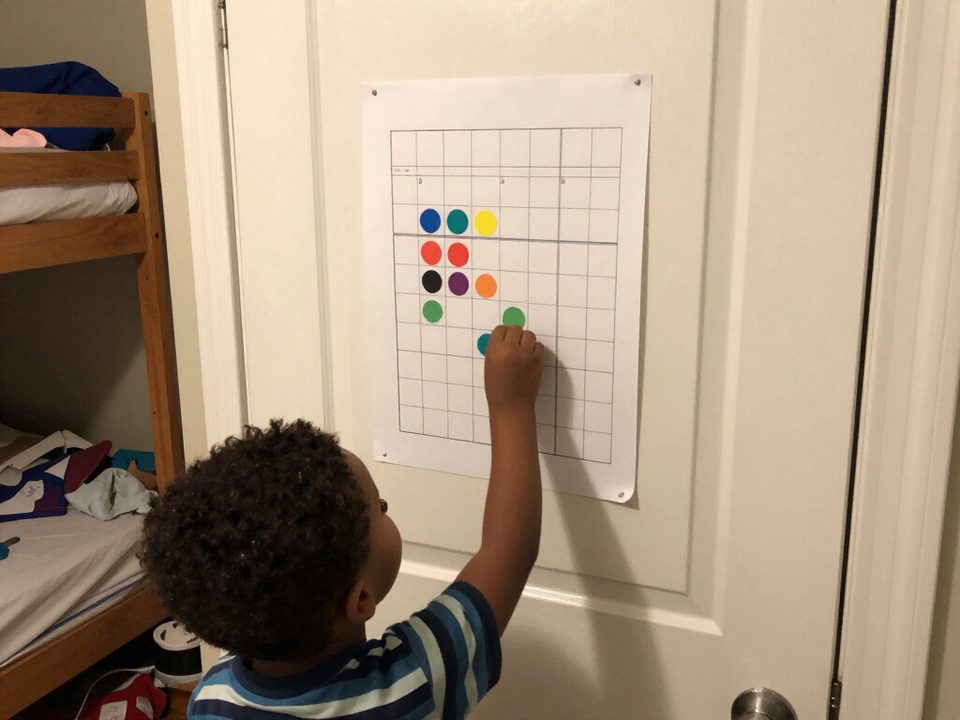
Download the charts
One-page PDFs with a blank name line. Pick paper and ink once, every button changes.

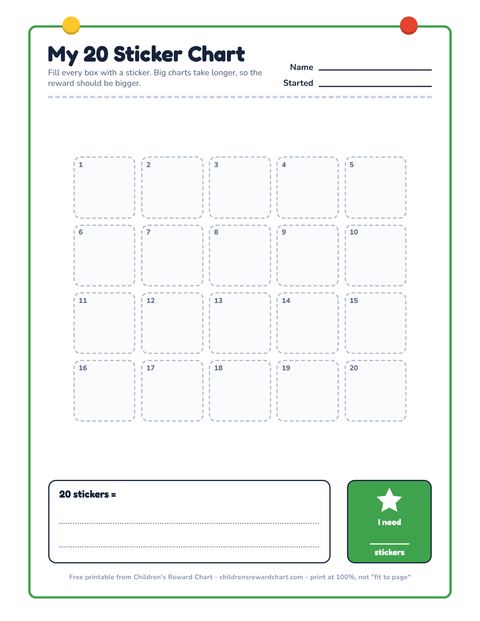
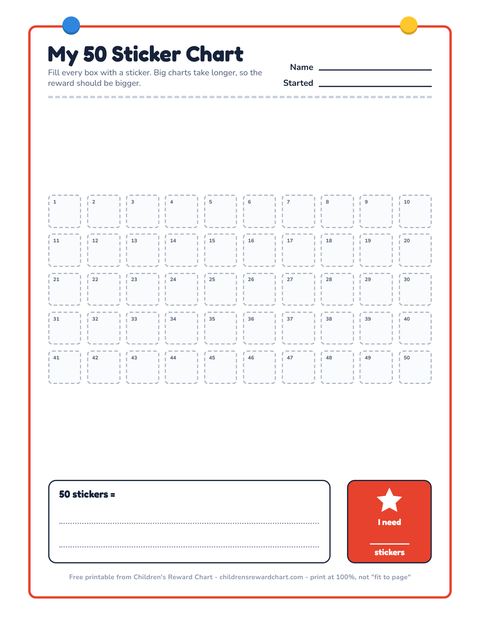
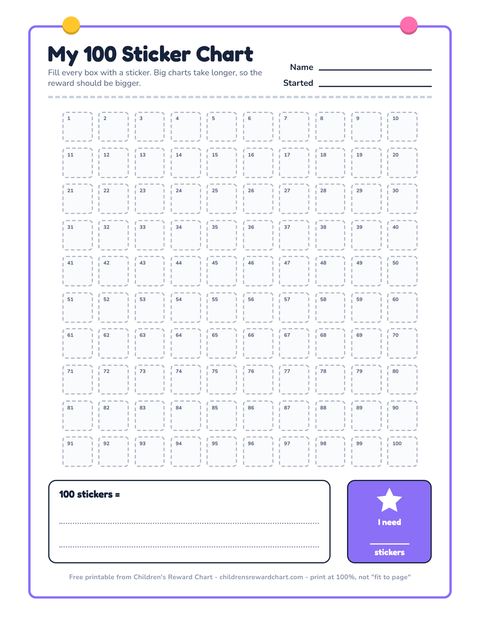
How many squares
The squares on a sticker chart are not just decoration. They tell your child how many days until the reward. If the chart is too long, the reward feels far away and the chart fizzles. If it is too short, the habit does not have time to stick.
Use this simple rule: one square per day, and the reward should come within two weeks for a child under 6. Older kids can wait a bit longer, but not much. The chart below matches each chart to an age and a reward size.
| Chart | Age | How long it takes | Reward size |
|---|---|---|---|
| 10 squares | 3 to 4 | 10 days | Small treat |
| 20 squares | 4 to 5 | 20 days | Medium treat |
| 50 squares | 6 to 8 | 50 days | Bigger treat |
| 100 squares | 8 to 10 | 100 days | Large reward |
For a 3 year old, a 10 square chart is plenty. For a 9 year old, a 100 square chart can work if the reward is worth the wait. If you are not sure, start smaller. A finished chart beats a half full one every time.
The four sticker charts
Each printable sticker chart is a one page PDF with numbered squares. The squares are sized for a half inch sticker, so a star or small round sticker fits right in. There is a line for your child's name and a line for the reward at the bottom.
You get each chart in letter and A4, and in color or ink saving black outline. Print at 100 percent, not fit to page. That keeps the squares the right size for your stickers.
Pick the chart that matches the number of days you want to track. You can print one chart or all four. They are free to download and use as many times as you like.
What earns a sticker
Choose one habit or one behavior to work on. Write it on the chart in plain words. Examples: brush teeth, put away toys, or say please. Do not list three chores on one chart. One clear behavior is easier for a child to remember.
When your child does the behavior, give the sticker within a minute. Let your child stick it on the square. That instant connection is what makes the chart work. You can read more about why stickers work in our guide.
For a 3 year old, use a simple behavior like sitting on the potty. For a 5 year old, try making the bed or clearing the plate. For an 8 year old, use homework done before dinner. Match the behavior to your child's age and ability.
Stickers that fit the squares
The squares on every chart fit a half inch star sticker or a small round sticker. For the 10 and 20 square charts, you can also use 1 inch round labels if you want a bigger sticker. Just make sure the sticker is not wider than the square.
Let your child pick the sticker sheet. A favorite character or color makes the chart more fun. You can find sticker sheets on Amazon, and the site earns a commission if you buy through our links. See the stickers page for options.
The right sticker size keeps the chart neat and the squares visible. If the sticker is too big, it covers the number and the chart gets messy. Half inch stars are the safest choice for all four charts.
When the chart is full
The day the last square gets a sticker, give the reward that same day. Do not wait for the weekend or a special time. The connection between the full chart and the reward is what your child remembers.
Take a photo of the full chart before you take it down. Your child will love looking back at it. Then decide what comes next. You can start a bigger chart, take a break, or move to to a different habit.
Never restart the same chart for the same habit more than twice. If the chart is full and the habit is not solid, pick a different reward or a new approach. You can also switch to a chore chart or a behavior chart for a fresh start.
More reward and star charts
Every page hands out its own chart. All reward and star charts.
Bedtime sticker chart and sleep chart
Bedtime routine + dry night
Free printableHomework chart
Homework tracker
Free printableReading chart and reading log for kids
Reading log 20 books
Free printableReward ideas and reward systems for kids (non-food, cheap, free)
Reward coupons + reward box labels
Free printableStar chart for kids
Star chart 10, 20, 30 stars
Free printableReward stickers that fit these charts
None (Amazon layer)
Free printableFree printable reward chart templates
Blank + editable
Free printableGuides on rewards and stickers
Short guides that end at a chart you can print tonight.

Why stickers work on a chart, and when they stop
Understand why stickers work on a chart, and what to do when they stop working.

Incentive chart vs reward chart: which one to print
Compare an incentive chart and a reward chart, and decide which one to print for your child.

Reward chart ideas: 30 goals and rewards by age
Choose from 30 reward chart ideas by age, with goals and rewards that actually motivate.
Print it, then stick it to the fridge
Sticker paper that fits every chart on this site, and the bits that keep a chart up all week. Links go to Amazon and we may earn a commission.
Goes with a reward chart
The jar, the prize box and the stars the chart is working toward.
Questions parents ask
How many squares should a sticker chart have?
For a child under 6, use 10 or 20 squares so the reward comes within two weeks. For ages 6 to 8, 50 squares can work. For 8 to 10, 100 squares is fine if the reward is big enough. Start smaller if you are unsure.
What size stickers fit a sticker chart?
Half inch star stickers fit every chart. Small round stickers also work. For the 10 and 20 square charts, you can use 1 inch round labels. Print at 100 percent so the squares stay the right size.
What should a sticker chart be for?
Use it for one specific behavior, not a list of chores. Examples include brushing teeth, putting away toys, or completing homework. Write the behavior on the chart so your child knows exactly what earns a sticker.
What happens when the sticker chart is full?
Give the reward the same day the chart is full. Take a photo of the chart first. Then decide if you will start a new chart, take a break, or move to a different habit. Do not restart the same chart more than twice for the same behavior.