Reward chart ideas: 30 goals and rewards by age
A reward chart idea is a goal paired with a fitting reward. This guide lists 30 pairs by age, plus goals to skip and rewards to avoid, so you can start tonight.

Reward chart ideas work when the goal and the reward match the child in front of you. A 3 year old needs a same-day prize, while a 9 year old wants a say in the plan. Here are 30 pairs, sorted by age, plus the traps that make charts fizzle.
An idea is a pair
A reward chart idea is never just a goal or just a reward. It is both, joined on one line. The goal is the behavior you want to see, like “put shoes by the door.” The reward is the thing the child gets for the stickers that follow.
When one half is missing, the chart fizzels. A goal without a reward asks a child to work for nothing. A reward without a goal is a treat with no reason behind it. Write them as a pair, and the chart has a clear job.
Read the lists below as pairs. The goal goes on the chart line. The reward goes on the sticker line. Pick one pair for one week. Print the chart, read the pair to your child, and start tonight.
For a quick start, see the reward chart ideas page for printable pair cards.
Reward chart ideas for 3 to 4 year olds
At this age, a child understands “now” better than “Friday.” Keep the goal to one small action and the reward to something the child can hold or do the same day. Three boxes on the chart are plenty for a 3 year old, and five work for a 4 year old.
Use pictures, not words, for the goal. Draw a toothbrush or a shoe. The child sees the picture, does the task, and places a sticker. The reward is immediate, like a sticker on the hand or a special song at bedtime.
Here are 8 pairs for this age.
- Goal: brush teeth without crying. Reward: one sticker on your hand after breakfast.
- Goal: put one toy in the bin. Reward: pick the bedtime story tonight.
- Goal: wash hands before snack. Reward: draw one line with a washable marker.
- Goal: put cup in the sink. Reward: blow a bubble with gum for 2 minutes.
- Goal: get dressed with help. Reward: jump on the bed 10 times.
- Goal: sit on the potty. Reward: read one extra page at story time.
- Goal: say “please” at dinner. Reward: choose the song in the car.
- Goal: hold your parent’s hand in the lot. Reward: walk backward to the door.
Print a sticker chart with 5 boxes for the 3 year old and 10 boxes for the 4 year old. Tape it at eye level in the kitchen.
Ideas for 5 to 6 year olds
Five and 6 year olds can wait a few days for a reward, but a full week is still too long. Plan for a reward on Saturday morning for work done Monday through Friday. The goal can have two steps, like “make bed and put pajamas away.”
The reward should be an activity or a small item, not a pile of candy. A child this age loves to earn time with a parent, a new crayon, or a trip to the playground. Write the goal and reward on the chart so the child can see the pair.
Here are 8 pairs for this age.
- Goal: make bed each morning. Reward: choose Saturday’s pancake shape.
- Goal: put lunchbox in the sink. Reward: 15 extra minutes of play outside.
- Goal: clear your plate after dinner. Reward: pick a movie for family night.
- Goal: brush teeth morning and night. Reward: one new sticker for your collection.
- Goal: put dirty clothes in the hamper. Reward: a bubble bath with bath toys.
- Goal: feed the dog with help. Reward: choose the game for family game night.
- Goal: put on shoes without a fight. Reward: walk to the corner store for a drink.
- Goal: use a quiet voice inside. Reward: one extra song before bed.
Use the star chart for this age. The 1/2 inch star stickers fit the boxes, and the child can place them without help.
If the chart slows down, read why stickers work for a refresher on timing.
Ideas for 7 to 8 year olds
Seven and 8 year olds understand points and privileges. The goal can be a routine with three steps, like “homework, backpack, and shoes in the closet.” The reward can be a privilege that lasts a day, like chosing the family dinner or staying up 15 minutes later.
This is the age to introduce a points system. Each sticker is worth one point. Five points earns a small reward, and ten points earns a bigger one. Write the points on the chart so the child can count along.
Here are 7 pairs for this age.
- Goal: finish homework before 5 pm. Reward: 30 minutes of screen time.
- Goal: pack your own snack. Reward: choose the radio station in the car.
- Goal: put away your laundry. Reward: pick a dessert for Friday.
- Goal: read for 15 minutes. Reward: one extra chapter read aloud by a parent.
- Goal: set the table without being asked. Reward: choose the family walk route.
- Goal: take out the recycling. Reward: a later bedtime on Saturday.
- Goal: practice an instrument for 10 minutes. Reward: pick a new song to learn.
The weekly chart works well here. Print it at 100 percent so the boxes fit the stickers.
Ideas for 9 and up
A 9 year old or older child wants a say in the plan. Sit down together and ask, “What would make this worth it?” The goal can be a weekly chore or a habit, and the reward should be a trust-based privilege, like a later bedtime or a solo trip to the park.
Write the pair together on the chart. The child chooses the reward from a list you approve. This turns the chart from a parent rule into a shared deal.
Here are 7 pairs for this age.
- Goal: finish all homework before dinner. Reward: 15 extra minutes on a device.
- Goal: wash the dishes three nights. Reward: choose the Sunday family activity.
- Goal: fold and put away your clothes. Reward: pick a new app or game.
- Goal: walk the dog each day. Reward: a friend sleeps over on Saturday.
- Goal: keep your room floor clear. Reward: a later bedtime on weekends.
- Goal: make your own lunch. Reward: choose the takeout order on Friday.
- Goal: help with yard work for 20 minutes. Reward: earn a small allowance for a treat.
Use the template and write the goal and reward in your child’s handwriting. Post it on the fridge where both of you can see it.
Goals that do not belong on a chart
Some goals sound good but break a chart. They depend on a feeling or a result the child cannot control. When the goal is out of reach, the chart teaches failure, not habit.
Here are 5 goals to keep off the chart, with what to do instead.
- Getting an A on a test. Instead: track “studied for 15 minutes.”
- Eating everything on the plate. Instead: track “tried one bite of a new food.”
- Not feeling angry. Instead: track “used a calm-down spot for 2 minutes.”
- Falling asleep alone. Instead: track “stayed in bed for 10 minutes after lights out.”
- Being nice to a sibling. Instead: track “said one kind word to your brother.”
When the goal is a behavior the child can do, the chart has a fair chance. If the chart still stalls, read why your chart is not working for fixes.
Rewards to avoid
Some rewards undermine the chart or cause new battles. The table below shows common traps and a better swap. The swap keeps the child excited without the downside.
Choose rewards that are small, immediate, and tied to the goal. Avoid anything that takes a week to arrive or costs a special trip.
| Reward | Problem | Swap for |
|---|---|---|
| Candy | Sugar spike, loses value | Sticker on hand |
| Screens | Hard to end, fights | Extra story time |
| Money under 7 | Too abstract | Pick a small toy |
| Big toys | Too far away | Small daily prize |
| Taking things away | Feels like punishment | Add a privilege |
The best reward is something the child can see or do within a day. For more swap ideas, see the chore chart rewards page.
Print the chart that fits the idea
Once you pick a pair, print the chart that matches the age and the goal. The weekly chart is good for 5 and up. The star chart works for younger kids. The sticker chart is for one simple goal.
For a custom chart, use the template and draw the goal and reward in the boxes. All charts come in letter and A4, in color or ink saving. Print at 100 percent, not “fit to page,” so the stickers line up.
The downloads page has all the files in one place. Print one chart, put it on the fridge, and start with a single pair tonight.
Charts that go with this guide
Free one-page PDFs with a blank name line. Pick paper and ink once, every button changes.
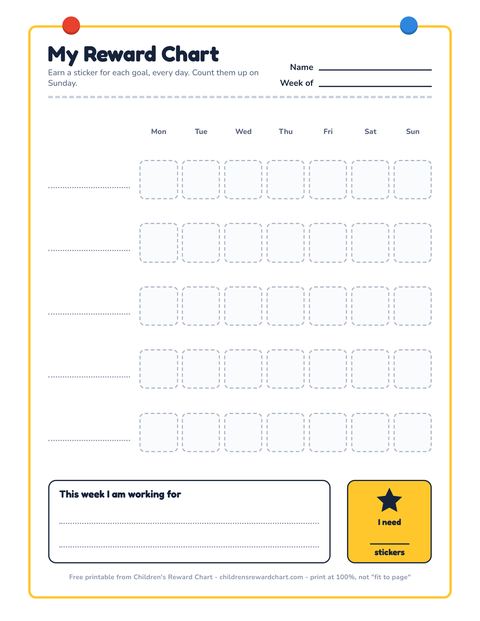
My Reward Chart
Weekly reward chart in yellow: 5 goals, 7 days, reward and target boxes.
Download letter PDF
My 20 Star Chart
20 numbered star boxes and a reward line. Fits a 1/2 inch star sticker.
Download letter PDF
Reward Coupons
8 cut-out reward coupons: stay up late, pick the movie, park trip and more.
Download letter PDFStickers and paper for the chart
The reinforcer has to be in the drawer before the first star is earned. Links go to Amazon and we may earn a commission.
Questions parents ask
What are good reward chart ideas?
A good idea is a goal paired with a fitting reward. For a 3 year old, try “brush teeth” with a same-day sticker. For a 7 year old, use “homework done” with 30 minutes of play. Match the reward to the child’s age and the goal to one clear action.
What goals should go on a reward chart?
Goals must be actions the child can control. Use “put shoes by the door” instead of “be responsible.” Use “try one bite” instead of “eat everything.” Keep the goal to one or two steps, and write it in words the child understands.
What are good rewards for a reward chart?
Good rewards are small, immediate, and free of negotiation. For young kids, use stickers, a special song, or extra playtime. For older kids, use privileges like a later bedtime or choosing the family movie. Avoid candy and screens, which lose value fast.
What reward chart ideas work for a 3 year old?
Use a picture goal and a same-day reward. Draw a toothbrush and offer a sticker on the hand after breakfast. Keep the chart to three boxes. A 3 year old cannot wait a week, so the reward must come within minutes of the behavior.
Should the reward be a toy?
A toy can work for a bigger goal, but only if it is small and earned in a few days. A big toy that takes a month will lose the child’s interest. For daily charts, use activities or privileges instead, like extra story time or choosing the song.
Read next
Short guides that end at a chart you can print tonight.

Why stickers work on a chart, and when they stop
Understand why stickers work on a chart, and what to do when they stop working.

Incentive chart vs reward chart: which one to print
Compare an incentive chart and a reward chart, and decide which one to print for your child.

Reward chart not working? Eight fixes in order
Fix a reward chart that has stalled, with eight fixes you can try in order.