Why stickers work on a chart, and when they stop
A sticker chart works because the child places the sticker. The moment that matters is the child's hand on the chart, not the sticker itself. When you start placing stickers to save time, the chart starts to fail.

Sticker reward charts work because a sticker is a reinforcer that arrives on time. The child does the behavior, and within a minute there is a visible mark they placed themselves. That is why stickers work, and it is also why they stop working when you take over the placing.
The sticker is the reinforcer arriving on time
A sticker works because it lands in the minute after the behavior. Your child puts a toy away, and the sticker is already there, on the chart, in their line of sight. That speed matters more than the sticker's color or shape. The brain connects the action to the mark because they happen close together.
This is operant conditioning, and you do not need a psychology degree to use it. You need a sticker within arm's reach and a chart on the wall. A sticker is fast, cheap and visible. It does not interrupt the evening like a treat or a screen does.
The sticker also works because it is a physical record. Your child can see the row growing. They can count the boxes. They can point to yesterday's star and say, I did that. That visible proof is part of the reward, and it is why a plain sticker on a paper chart beats a token on a screen.
The child's hand on the chart
The placing is the reward. When your child peels the backing and presses the sticker into the box, they are doing the work of celebration. Their hand on the chart makes the behavior theirs. The sticker is the tool, but the moment of control is what sticks.
The day you start sticking them on to save time is the day the chart starts to fail. It feels harmless: your child is tired, the bedtime routine is dragging, and you slap the star on yourself. But that one move changes the meaning. The child becomes a spectator to their own reward.
The rule is simple. The child places the sticker, every time. If they are too young to peel the backing, you peel it and hand it to them. They press it down. If they miss the box, let it be crooked. The crooked sticker is still their sticker.
This is the brand angle of this whole guide: the sticker itself matters less than the hand that places it. Keep your hands off the chart and your child's hands on it.
Why the sticker itself matters less than you think
Parents often shop for the perfect sticker: the shiny one, the scratch and sniff, the one with their child's favorite cartoon. But the child's hand on the chart is the reward. The sticker just needs to be peelable and visible.
A plain gold star works because it is a star. A smiley works because it is a face. The fancy sticker works for a week, and then it is just another sticker. What keeps a chart alive is the routine of placing, not the novelty of the image.
Here is a quick look at common stickers and what to watch for.
| Sticker | Works for | Watch out |
|---|---|---|
| Gold star | Classic, clear reward | Feels plain after a week |
| Smiley | Young kids, 3 to 5 | Can feel like a judgment |
| Animal | Kids who love creatures | Kids fight over who gets which |
| Scratch and sniff | Sensory kids | Smell fades fast |
| Name sticker | Ownership, older kids | Not a reward, a label |
The best sticker is the one your child can place without help. If the sticker is too small or too sticky, the placing becomes a struggle. A 1.5 inch round sticker or a 1/2 inch star fits the boxes on every chart on this site. That size is easy for small hands to grip and press.
When stickers stop working
Every sticker chart fizzles at some point. The question is not if, but when. You can catch the fade early if you know the signs. Here are six signs that your chart is losing its pull.
- The child stops asking for the sticker
- The chart has gaps, days with no sticker
- The reward is late, you give it an hour after the behavior
- The same chart has been on the wall for a month
- The sticker is placed on the parent's terms, not the child's
- A sibling has a better sticker or a better chart
If you see one of these signs, do not panic. A chart is a tool, not a contract. The next section covers what to do when the sticker stops landing.
What to do when they stop
Change the reward, not the chart. The chart is the structure. The reward is the fuel. If your child stopped caring about the sticker, swap the sticker for a small privilege: 10 minutes of choosing the music, or a later bedtime on Friday. Keep the same chart and the same placing ritual.
Shrink the chart. A full month of boxes can feel like a mountain. Print a chart with 7 boxes, or just 5. A short chart gives a quicker win. You can always tape a second chart below the first.
Take a week off. Put the chart in a drawer and say nothing. Some children come back to it with fresh eyes. Some do not. If they do not, you have learned that the behavior is now a habit, or that the reward needs to change.
Try a new theme. A star chart becomes a rocket chart. A chore chart becomes a dinosaur chart. The theme is not the reward, but it can restart the interest.
For children 8 and up, move to points. A point is a sticker without the peel. They can tally points in a notebook, and the points add up to a bigger reward. The hand that writes the point is still the child's hand.
Stickers by age
A sticker chart works differently at different ages. The sticker is the same, but the meaning shifts. Here is what to expect from ages 3 to 9.
- Age 3: the sticker is everything. The peel, the press, the shine. The behavior is secondary.
- Age 5: the count matters. They want to know how many boxes are filled and how many are left.
- Age 7: the reward line matters. They ask what the chart is for and what they get at the end.
- Age 9: points, checks, privacy. A sticker feels babyish. A point in a private notebook works better.
The age ranges are not fixed. Some 4 year olds are ready for points, and some 10 year olds still love a sticker. Watch your child, not the calendar.
Fading stickers on purpose
The goal of a sticker chart is to make the behavior automatic, so the chart becmoes unnecessary. Fade the stickers on purpose. Start by giving a sticker every other day, then weekly, then stop entirely. Take the chart down and say, You have been doing this so well, we do not need the chart anymore. The habit stays because the behavior became routine. The chart was a scaffold, and the scaffold can come down.
The sticker paper and the name stickers
The charts on this site are one page PDFs in letter and A4, with a blank name line. The reward boxes fit a 1.5 inch round sticker or a 1/2 inch star sticker. You can print at 100 percent, not fit to page, and the boxes will line up.
If you sign up with your email, the builder prints the child's name on a sticker sheet, a star chart and a chore chart, all made in the browser. That name sticker is a small thing, but it makes the chart feel owned. See the sticker chart for the printable version. You can also compare the star chart and the behavior chart options. For more on how to keep a chart alive, read positive reinforcement examples. And if you are deciding between a chart and a diferent system, the incentive chart vs reward chart guide helps.
Charts that go with this guide
Free one-page PDFs with a blank name line. Pick paper and ink once, every button changes.
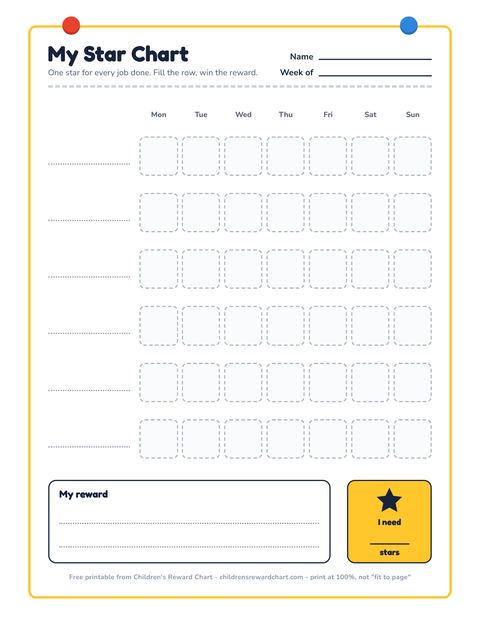
My Star Chart
7 days, 6 blank tasks, one reward box. The chart everyone starts with.
Download letter PDF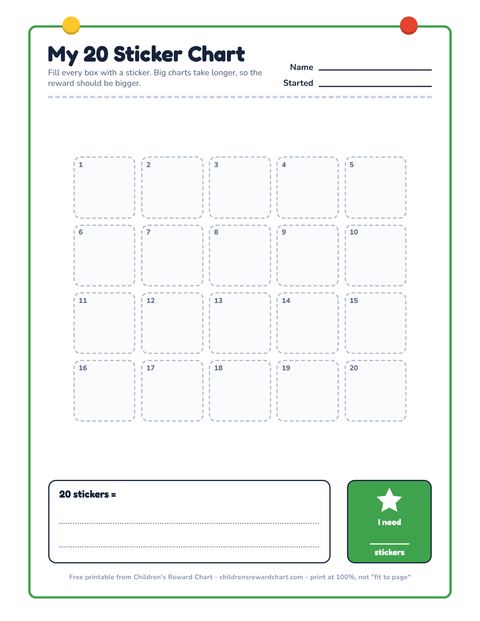
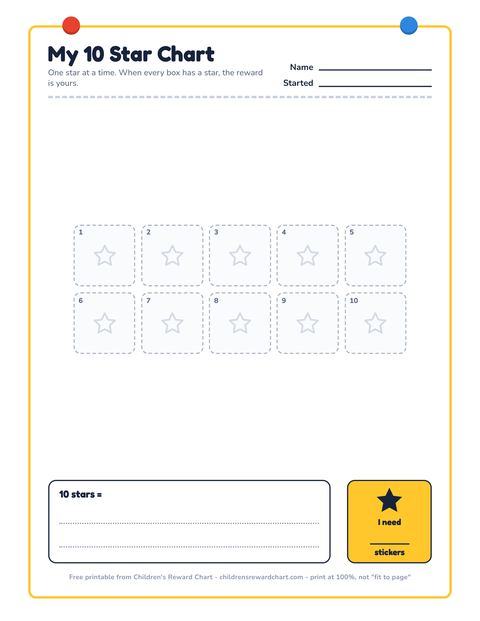
My 10 Star Chart
10 numbered star boxes and a reward line. Fits a 1/2 inch star sticker.
Download letter PDFStickers and paper for the chart
The reinforcer has to be in the drawer before the first star is earned. Links go to Amazon and we may earn a commission.
Questions parents ask
Why do sticker charts work?
Sticker charts work because the sticker arrives right after the behavior, so the child connects the action to the reward. The child places the sticker themselves, which makes the reward feel earned. The visible row of stickers also gives a sense of progress that words alone cannot match.
Who should put the sticker on the chart?
The child should place the sticker, every time. If they are too young to peel the backing, you peel it and hand it to them. They press it down. When the parent places the sticker, the child becomes a spectator, and the chart loses its power.
What stickers work best on a reward chart?
A 1.5 inch round sticker or a 1/2 inch star sticker fits the boxes on the charts on this site. Gold stars are classic and clear. Smileys work for young kids. Scratch and sniff stickers are fun but the smell fades. The best sticker is one the child can place easily.
Why did my sticker chart stop working?
The most common reason is that the parent started placing the stickers to save time. Other reasons: the reward was late, the same chart ran for a month, or a sibling had a better sticker. Change the reward, shrink the chart, or take a week off.
At what age do stickers stop working?
Most children lose interest around age 8 or 9, but it varies. Some 4 year olds are ready for points, and some 10 year olds still love a sticker. Watch your child. When the sticker stops landing, switch to points, checks, or a private notebook.
Read next
Short guides that end at a chart you can print tonight.

Incentive chart vs reward chart: which one to print
Compare an incentive chart and a reward chart, and decide which one to print for your child.

Reward chart ideas: 30 goals and rewards by age
Choose from 30 reward chart ideas by age, with goals and rewards that actually motivate.

Reward chart not working? Eight fixes in order
Fix a reward chart that has stalled, with eight fixes you can try in order.