Reward chart not working? Eight fixes in order
When a reward chart stops working, the chart is rarely the problem. Work through these eight fixes in order, trying each one for three days, to find the real cause and get the chart going again.

If your reward chart not working has you ready to toss it, stop. The chart is almost never the problem. These eight fixes are ordered by how often each one is the real cause, so you try them in order for three days each.
First, what 'not working' means
Before you change anything, name the exact way the chart is failing. There are three versions: it never started, it stopped after a week, or it works only when you stand there watching. Each version points to a different fix.
A chart that never started usually means the reward is too far away or the goal is too vague. A chart that stopped after a week often means the sticker arrives too late or the rows are too many. A chart that works only when you watch means the chart is out of sight or the child is done with it.
Match your version to the fix below and give that fix three full days. No switching after one night.
Fix 1: the sticker arrives late
The most common reason a sticker chart not working is the delay between the behavior and the sticker. If you wait until bedtime to hand out stickers, the connection is already cold. A child of three to ten needs the sticker within a minute of the behavior.
Keep the sticker sheet and the chart in the room where the behavior happens. The moment you see the behavior, say what you saw and hand the sticker over. The child sticks it on the chart, not you.
Try this for three days. If the chart still fails, move to fix two.
Fix 2: the reward is too big and too far
A reward that takes two weeks to reach is invisible to a young child. The fix is smaller and sooner. A child can hold a plan for about three days, so the reward should come at day three, not day fourteen.
Use a chart with 10 boxes. Ten stickers, one per day, means a reward on day ten. That is still too long for a three year old. Cut the chart to 5 boxes, or fill two boxes a day for a 10 box chart, so the reward lands in three days.
Pick a reward from the reward ideas page that is small, like a special snack or ten minutes of a favorite game. Try this for three days.
Fix 3: too many rows
A chart with five rows asks a child to change five behaviors at once. That is too much. The brain can only point at one goal at a time. Cut the chart down to one row, one behavior, one sticker per day.
The star chart is built for this. One row of stars, one behavior written at the top. When that behavior is solid for two weeks, add a second row. Do not add a row just because the first one works.
Try one row for three days. If the behavior is still weak, move to fix four.
Fix 4: the goal cannot be pointed at
A goal like 'be good' or 'help around the house' has no moment a parent can point to. The child does not know when the behavior happened. Rewrite the goal as a moment that you can see and name.
Here are five vague goals rewritten as pointable moments.
Vague | Pointable
Be nice | Say please without a reminder
Clean up | Put three toys in the bin
Do homework | Open the book and write one line
Get ready | Put on socks and shoes
Listen | Look at me when I speak
| Vague | Pointable |
|---|---|
| Be nice | Say please without a reminder |
| Clean up | Put three toys in the bin |
| Do homework | Open the book and write one line |
| Get ready | Put on socks and shoes |
| Listen | Look at me when I speak |
Write the pointable goal on the chart. When you see it happen, you hand over the sticker. Try this for three days.
Fix 5: stickers are being taken away
If you remove stickers for bad behavior, the chart dies. A sticker that can be lost is not a reward, it is a threat. The child stops trusting the chart and stops caring about earning stickers.
The rule is simple: nothing comes off. Once a sticker is on the chart, it stays. Even if the child throws a tantrum five minutes later, the sticker remains. The sticker is a record of one good moment, not a bank account.
Removal kills a chart because it teaches the child that effort can be erased. That is a hard lesson and it makes the next chart harder. If you have been taking stickers away, stop tonight and apologize. Try this for three days.
Fix 6: the chart is out of sight
A chart on the fridge in the kitchen does nothing for a behavior that happens in the playroom. The chart has to be where the behavior happens, at the child's eye level. That means a chart on the wall at there height, not yours.
If the behavior is cleaning toys, hang the chart near the toy bin. If it is getting dressed, hang it in the bedroom. The child should see the chart without being told to look at it. Use a clipboard or a command hook so it can move with the behavior.
Try this for three days. If the chart still fails, move to fixes seven and eight.
Fixes 7 and 8: the wrong tool, or the child is done
Some behaviors are not chores, they are routines. A routine chart lists steps like brush teeth, put on pajamas, read a book. A reward chart with stickers does not fit a routine. Use a behavior chart made for routines instead.
Some children, especialy older ones, are simply done with sticker charts. If the habit is already stuck, the chart has done its job. Retire it with a small celebration and move on. If the child is older and needs more structure, a behavior chart for ADHD might fit better.
A short-interval chart works when the child needs to see progress in hours, not days. A chart with a box for each morning and afternoon can help a child who cannot wait until bedtime. This is the last fix because it is the rarest cause.
If you are wondering whether rewards are the right idea at all, read why stickers work and is rewarding behavior bribery. Then pick the right tool from the downloads page.
Charts that go with this guide
Free one-page PDFs with a blank name line. Pick paper and ink once, every button changes.
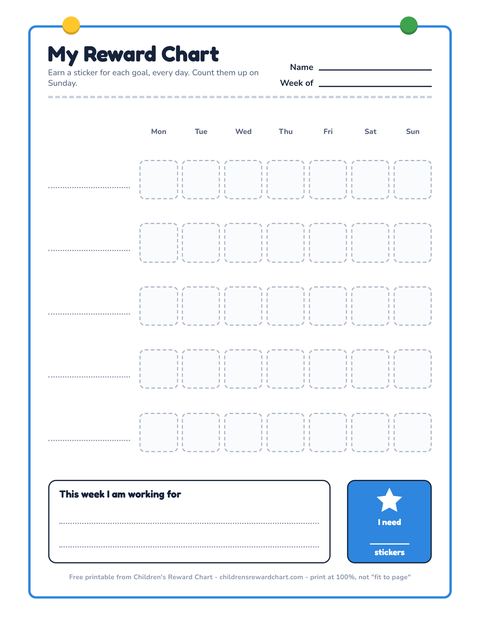
My Reward Chart
Weekly reward chart in blue: 5 goals, 7 days, reward and target boxes.
Download letter PDF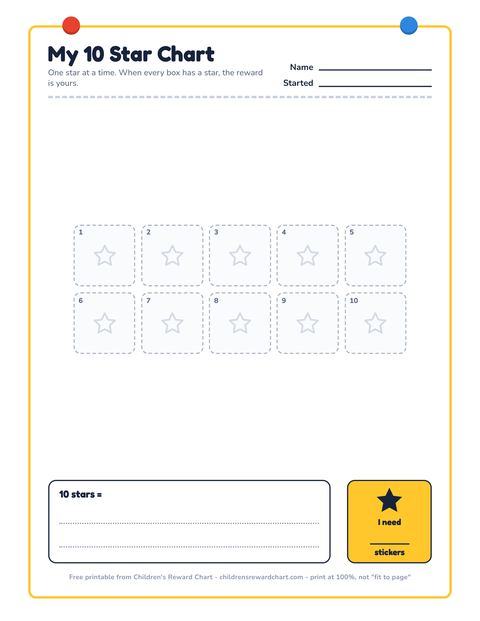
My 10 Star Chart
10 numbered star boxes and a reward line. Fits a 1/2 inch star sticker.
Download letter PDF
Stickers and paper for the chart
The reinforcer has to be in the drawer before the first star is earned. Links go to Amazon and we may earn a commission.
Questions parents ask
Why is my reward chart not working?
The chart is rarely the problem. The most common causes are a late sticker, a reward that is too far away, or too many rows. Work through the fixes in order, trying each for three days, and you will find the real cause.
What do I do when my child stops caring about the sticker chart?
Check the timing first. Is the sticker arriving within a minute of the behavior? Then check the reward. Is it small and available in three days? If both are right, the child may be done with the chart, which is a sign of success.
How long should I try a reward chart before giving up?
Try each fix for three days before changing anything. If you have gone through all eight fixes and the chart still fails, put it away for a month. The child may simply be too young or too old for this tool right now.
Should I take stickers away?
No. Once a sticker is on the chart, it stays. Taking stickers away teaches the child that effort can be erased. It makes the chart feel like a threat, not a reward, and it makes the next chart much harder to start.
Is my child too old for a reward chart?
Most children age out between seven and ten. If your child can plan for a week and keep a habit without a chart, they are done. Retire the chart with a celebration and switch to a routine chart or a simple verbal agreement.
Read next
Short guides that end at a chart you can print tonight.

Why stickers work on a chart, and when they stop
Understand why stickers work on a chart, and what to do when they stop working.

Incentive chart vs reward chart: which one to print
Compare an incentive chart and a reward chart, and decide which one to print for your child.

Reward chart ideas: 30 goals and rewards by age
Choose from 30 reward chart ideas by age, with goals and rewards that actually motivate.