- Home
- Reward and star charts
- Reading chart and reading log for kids
Reading chart and reading log for kids
This reading chart for kids counts books, not minutes. A finished book is something a child can see and feel proud of. Fifteen minutes of reading is just a number on a clock.

Download the charts
One-page PDFs with a blank name line. Pick paper and ink once, every button changes.
My Reading Log
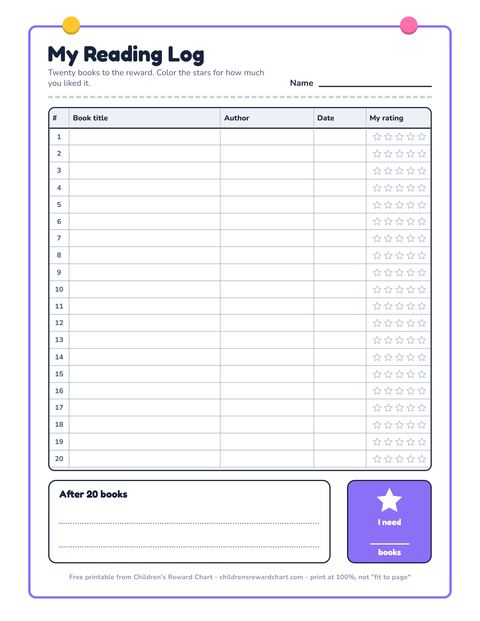
20-book reading log: title, author, date and a 5-star rating per line.
Download letter PDF
The 20 book reading log
The printable reading chart gives you 20 lines for book titles and dates. Each line has a row of five stars for your child to color in after they finish the book. The 21st line is the reward line, where you write the book your child picks as their prize.
There is a blank name line at the top, so the chart feels like theirs. You get both letter and A4 sizes in one PDF, with a color version and an ink saving black outline version. Print at 100 percent, not fit to page, so the boxes stay the right size for stickers. This log works well for kids aged 4 to 10.
Reward chart not working? Eight fixes in order is the guide that pairs with this chart.
Books, not minutes
Counting books works because a child can hold a book, close it, and put it on the pile. That pile is proof of there work. Minutes are invisible. A child cannot see fifteen minutes, but they can see a stack of five books.
Picture books count as books. A chapter in a longer book counts as a book for a 7 year old. The goal is to finish, not to read for a set time. From age 6, let your child write the title themselves. The writing is part of the ritual, and it gives them ownership of the chart.
This is simple operant conditioning. The behavior is reading a book. The reward is a star, a sticker, and eventually the book of their choice. The chart makes the connection clear.
Filling it in together
Keep the log by the bed so it is part of the nightly routine. Do it right after the last page is turned, while the story is still fresh. Here is the five step pattern that keeps it from fizzling out.
- Read the book together.
- Write the title on the next line.
- Color in the stars your child picks.
- Say one thing you both liked about it.
- Put a sticker on the line to seal it.
The one thing you say about the book is the part that builds connection. It can be as simple as, I liked the bear, or, That rhyme was silly. The sticker is the small ceremony that closes the book.
Reading reward ideas
The reward for finishing 20 books is the 21st book, and your child picks it. That is the prize on the chart itself. You can also add smaller rewards along the way to keep the momentum going.
Here are eight ideas that do not involve screens or money.
- The next book chosen by the child
- A special trip to the library
- A new bookmark they pick out
- Reading inside a blanket tent
- A late night read 15 minutes past bedtime
- A book swap with a friend
- A fancy hot chocolate while reading
- A trip to the bookstore to browse
For more ideas, see our reward ideas page. The key is to make the reward about reading itself, not a toy. That keeps the habit tied to the joy of books.
Reading charts for a class
This log works for a class reading challenge too. Each child gets their own 20 book log, and you can track progress on a shared class points chart. The individual log is private, the class chart is public.
For a group, you can give a class reward when everyone finishes their log. A pajama and pillow day, a guest reader, or an extra recess all work well. See the classroom page for more setup tips. You can also pair this with a sticker chart for individual behavior goals.
More reward and star charts
Every page hands out its own chart. All reward and star charts.
Bedtime sticker chart and sleep chart
Bedtime routine + dry night
Free printableHomework chart
Homework tracker
Free printableReward ideas and reward systems for kids (non-food, cheap, free)
Reward coupons + reward box labels
Free printableStar chart for kids
Star chart 10, 20, 30 stars
Free printableSticker charts (blank, 10 to 100 squares)
Sticker chart 10/20/50/100
Free printableReward stickers that fit these charts
None (Amazon layer)
Free printableFree printable reward chart templates
Blank + editable
Free printableGuides on rewards and stickers
Short guides that end at a chart you can print tonight.

Why stickers work on a chart, and when they stop
Understand why stickers work on a chart, and what to do when they stop working.

Incentive chart vs reward chart: which one to print
Compare an incentive chart and a reward chart, and decide which one to print for your child.

Reward chart ideas: 30 goals and rewards by age
Choose from 30 reward chart ideas by age, with goals and rewards that actually motivate.
Print it, then stick it to the fridge
Sticker paper that fits every chart on this site, and the bits that keep a chart up all week. Links go to Amazon and we may earn a commission.
Goes with a reward chart
The jar, the prize box and the stars the chart is working toward.
Questions parents ask
How does a reading chart work?
Your child reads a book, writes the title on the next line, and colors in the stars. After 20 books, they earn the reward written on the 21st line. The chart makes progress visible and gives a clear finish line.
Should I count books or minutes?
Count books for a child under 10. A finished book is a concrete win. Minutes are abstract and hard for a young child to grasp. Books also encourage finishing a story, not just watching a clock.
What age is a reading log for?
This log is for ages 4 to 10. A 4 year old can color stars while you write the title. A 6 year old can write the title themselves. A 10 year old can manage the whole log alone.
What is a good reward for reading?
The best reward is the next book your child chooses. Other good options are a library trip, a new bookmark, or a late night read. Keep the reward tied to reading so the habit stays connected to joy.