- Home
- Chore charts
- Family chore chart for two, three or four ki
Family chore chart for two, three or four kids
A family chore chart for two, three or four kids puts every job and every name on one grid. This page argues for one chart per family, not one per child. You can grab the free printable family chore chart template at the end.
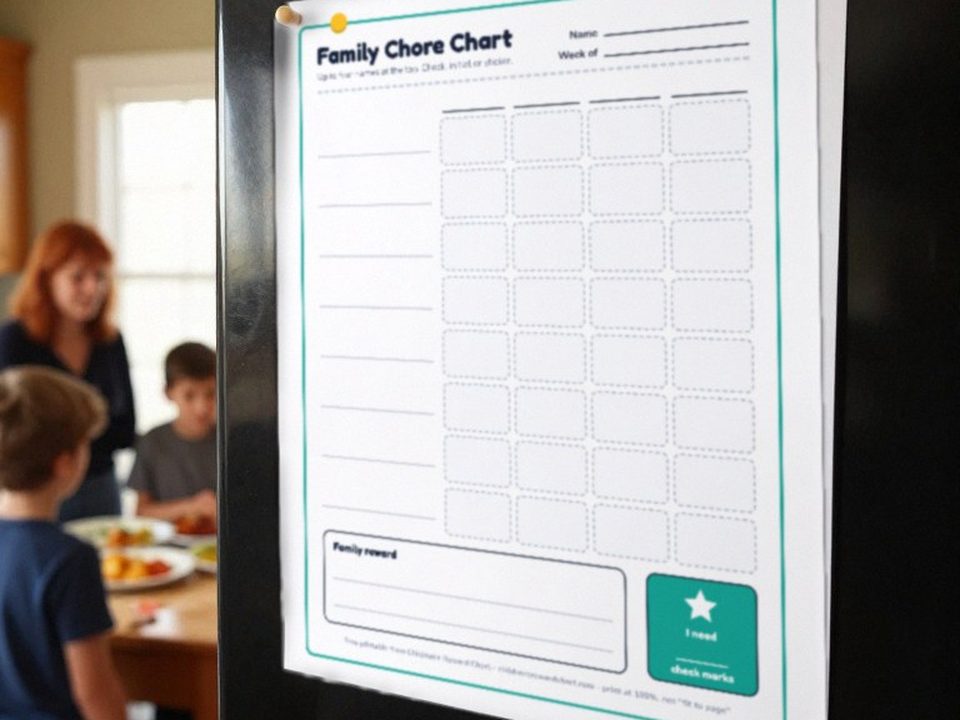
Download the charts
One-page PDFs with a blank name line. Pick paper and ink once, every button changes.


Why one chart beats one per child
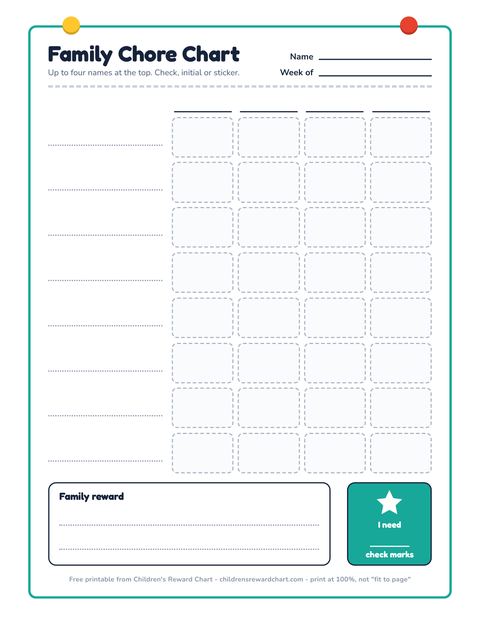
The 'that's not my job' argument dies when every job has a name in its column. A family chore chart is a grid of jobs down the side and names across the top, so each kid can see their own row of responsibility at a glance. One chart for the whole family stops the blame game because the chart shows exactly whose turn it is.
The family reward at the bottom needs every column filled. That means the kids have to check each other's work, not just do their own. Add a parent's column too, so mom or dad also has a job and a check mark. Siblings checking each other is part of the deal, and it works best when the chart is fair and visible.
Separate charts work better when there is a big age gap, like a teen and a 3-year-old. The teen's chores are not the little one's chores, and the little one's chart would be confusing. Use the by-age charts for that situation, and keep the family chart for when the kids can all read the same grid.
- Ends the 'that's not my job' argument
- One family reward at the bottom
- Parent's column shows everyone is in it together
- Siblings check each other's columns
- Separate charts only for big age gaps
Daily and weekly chores for kids on a family chart
Pick chores that fit the ages of your kids. The table below gives you a starting point for a family chart. You can swap jobs between kids as long as the grid stays full.
| Chore | Daily or weekly | Who can do it (age) |
|---|---|---|
| Set the table | Daily | 5 and up |
| Clear the table | Daily | 6 and up |
| Feed the pet | Daily | 7 and up |
| Take out trash | Weekly | 8 and up |
| Fold laundry | Weekly | 7 and up |
| Sweep the kitchen | Daily | 6 and up |
| Water plants | Weekly | 4 and up |
| Sort recycling | Weekly | 6 and up |
You can find more age-specific ideas in the chore charts by age guide. The printable weekly chore list has blank rows so you can add your own family jobs. Keep each kid to 2 or 3 rows on the chart, and rotate the weekly ones so nobody is stuck with the worst job all month.
How to create a family chore chart
Follow these six steps once, and you will have a chart that works all month. The free printable family chore chart template makes step 4 easy. The family meeting in step 5 is what makes it stick.
- List every household job on a scrap of paper
- Cross off the adult-only ones (like paying bills)
- Let each child claim the jobs they want
- Fill the grid: jobs down the side, names across the top
- Agree the family reward together
- Hang it in the kitchen at eye level
If you need help with step 5, see the rewards chart page for ideas that are not money. For step 2, the guides on household chores for kids explains what is age-apropriate. A sample family chore chart is in the templates download pack.
The 2-kid, 4-kid and monthly versions
The printable set has one chart for 2 kids, one for 3, and one for 4. Each chart has blank name columns at the top, so you fill in the names with a marker. The monthly version has the same jobs but a blank grid for rotating the jobs each week.
For the montlhy grid, write each child's name in a different column each week. That way the worst job moves around. The daily chart uses check marks for each day. For younger kids, let them put stickers on their own row. For older kids, initials work fine.
The downloads page has all the versions in one file. You can print one chart per month or one per week. The 3-year-olds and 4-year-olds charts have picture boxes instead of words, if that fits your family better.
Keeping it fair between siblings
Rotate the worst job every week. Nobody wants to take out the trash every single day. The monthly grid makes this easy because you just move the names down a column.
Give older kids more rows and harder jobs. A 10-year-old can handle 4 chores, a 6-year-old can handle 2. The 6-year-olds chart has a good starting point for the youngest ones.
The youngest gets fewer rows, but they still get a column on the family chart. Even a 4-year-old can wipe the table or put away toys. The 5-year-olds chart has simple jobs you can copy over.
Hold a family meeting when it feels unfair. Let each kid say one thing they want to change. Then adjust the chart together. The guide on making a chore chart has a script for that meeting.
More chore charts
Every page hands out its own chart. All chore charts.
Chores for 11 and 12 year olds (tweens)
Points + allowance chart
Free printableChores and chore chart for 3 year olds
Picture chore chart, 3 tasks
Free printableChores and chore chart for 4 year olds
Picture chore chart
Free printableChores and chore chart for 5 year olds (kindergarten)
Kindergarten chore chart
Free printableChores for 6 year olds
Weekly chore chart
Free printableChores for 7 year olds
Weekly chore chart
Free printableChores for 8 year olds
Weekly chore chart with points
Free printableChores for 9 and 10 year olds
Points chore chart
Free printableChore chart with allowance and payment
Allowance chart + payday tracker
Free printableChores for kids by age (3 to 12)
Age ladder chart, one PDF per age
Free printableChore chart rewards, ideas and chore boards
Reward coupons pack
Free printableChore chart for teenagers
Teen responsibility chart
Free printablePrintable chore chart templates (blank, editable PDF)
Blank + editable fillable PDF, letter + A4
Free printableGuides on chores and rewards
Short guides that end at a chart you can print tonight.
Should kids have chores? What changes at 3, 6 and 10
See what changes for chores at age 3, 6, and 10, and match the right chore chart to your child's stage.

How to make a chore chart that lasts past the first week
Build a chore chart that lasts past the first week, with simple steps you can do tonight.

How to get kids to do chores without nagging
Get kids to do chores without nagging, using a chart that makes the next step obvious.
Print it, then stick it to the fridge
Sticker paper that fits every chart on this site, and the bits that keep a chart up all week. Links go to Amazon and we may earn a commission.
Goes with a chore chart
A magnetic board for when paper has done its six weeks, a timer and the kid-size tools.
Questions parents ask
How do I make a family chore chart?
List every household job, cross off the adult-only ones, and let each child claim jobs. Fill a grid with jobs down the side and names across the top. Agree on a family reward, then hang it in the kitchen. The free template at the top of this page has the grid ready.
What chores can the whole family share?
Set and clear the table, feed the pet, sweep the kitchen, fold laundry, and take out trash. These are jobs that happen every day or every week, so they fit a family chart. Let each child pick the ones they can handle, and rotate the rest.
How do you keep a family chore chart fair?
Rotate the worst job weekly, give older kids more rows, and give the youngest fewer rows. Check that each child has at least one job they like. Hold a family meeting when someone says it is unfair, and change the chart together.
Should parents be on the family chore chart?
Yes. Add a parent column with one or two jobs like making dinner or paying bills. It shows that everyone in the family contributes. The kids are more likely to do their part when they see your name on the same chart.